Piers · House Leveling
Floors that slope and doors that stick, leveled from a survey of the whole floor
Pier and beam and slab homes across the Valley, raised in stages on proper bearing points. The survey is free, and you can stay in the house.
A house settles unevenly, and the cracks follow the low corner
Rio Grande Valley soil is heavy clay. It swells through a wet season and shrinks hard in drought, so the edge of a house moves on a different schedule from the middle of it. After a few cycles the difference shows up as a door that binds in one season and swings free in another, a marble that always rolls toward the same wall, and a crack above a doorway that reopens every summer.
Pier and beam floors fail in recognizable ways. Pads crumble, timber posts rot where they meet the ground, shims that were never fastened work themselves loose, and a joist splits or a beam gets notched too deep for a plumbing run. A floor that bounces underfoot is usually telling you the span between supports is too long. Slab homes show the same movement in door frames, tile lines and a gap opening between baseboard and floor.
Any one of those signs can be something else. Two or three on the same side of the house is a floor that has moved.
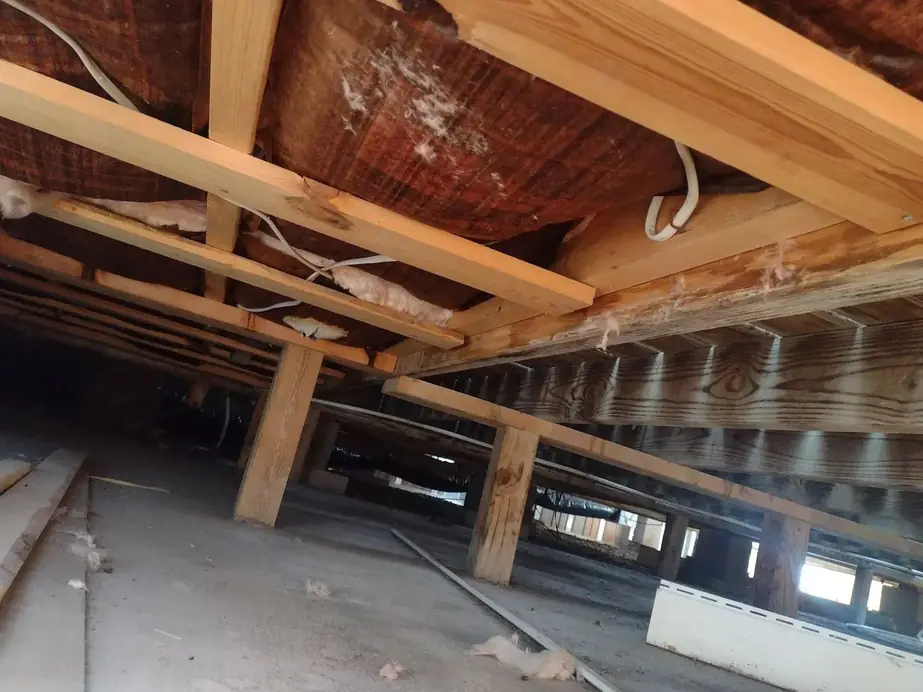
Floor joists, insulation and piers under a home
The survey comes first, then a slow lift
Ariston takes a full-floor elevation survey before it gives you a number, using a traditional water level, because the low point is rarely where the damage shows. A look at the worst corner would tell us where it hurts, not where the house has dropped. The readings are left with you, and the survey is free and carries no obligation.
The work follows what the survey finds. Low areas are raised back to elevation on the existing pier system where it is sound, and on new pads and posts where it is not. Failed bearing points are replaced with properly sized pads set on soil that has been checked. Split or rotted joists are sistered or replaced, a damaged beam is swapped out along with the detail that killed it, and a long span gets intermediate support so the bounce is fixed rather than hidden under new flooring.
The lift itself is deliberately slow, spread across the job, so drywall, tile and glass move together instead of cracking. Most Valley homes take 2 to 4 working days and owners can stay in the house. Ariston is licensed as a manufactured housing installer by the Texas Department of Housing & Community Affairs (MHDINS00004804) and is fully bonded and general-liability insured.
After the lift: water, finishes, and when to call again
Half the leveling problems in the Valley trace back to water sitting where it should not. While the crew is under the house in La Feria, Harlingen or McAllen, it checks whether the grade falls toward the structure and tells you plainly what would keep the correction from being undone in a few years: gutters and downspouts that carry water away, and soil built up so rain leaves instead of pooling at the footing.
Raising a house moves its finishes with it, so post-leveling repair is part of the conversation: drywall cracks, doors and windows that bind, and trim gaps that follow the lift.
If doors start to stick again, the same crack comes back, or a gap opens between skirting and floor, call (956) 345-7700 and ask for a fresh survey. Two readings a few years apart show whether anything is still moving.
Free floor survey, itemized written estimate, fully bonded and insured, TDHCA licensed installer MHDINS00004804.
Piers
What goes on the survey sheet
Every point on the floor is read against one datum. The sheet stays with you, so a second survey years later can be compared line for line. Questions about what you are seeing? Call (956) 345-7700. For a manufactured or park-model home, the mobile home leveling page covers piers and anchors.
- Datum
- The reference height every other reading is measured against, set with the water level before anything is lifted.
- Corners and perimeter
- Where clay moves first. A low corner points to drainage or a failed bearing point nearby.
- Mid-span
- A dip between two sound piers means a split joist or a span that is too long, not a sunk pier.
- Bearing points
- Pad, post and shim condition at each support: crumbled, rotted at ground contact, or loose.
- Door and window openings
- Binding frames tell us which direction the floor moved and how far the framing followed it.