Ridge · Storm & Hail Damage Repair
Hail and wind damage found slope by slope, then written down so an adjuster can read it
A dated photo report, a line-item estimate and repairs to manufacturer specs, with tarping when water is already coming in.
Hail bruises, wind lifts, and a roof can look fine from the driveway
Storms hurt Valley roofs in two different ways, and the repair is not the same. Hail strikes the surface. It bruises or fractures the shingle mat, knocks granules loose and dents soft metal such as vents, flashing and gutters, mostly on the slopes that faced the storm. Wind works at the edges. It lifts and creases shingles, breaks the adhesive seal that holds each course down, and pulls at ridge caps, drip edge and flashing.
A single storm often does both, and much of the damage cannot be seen from the ground. A bruised mat can look intact on top. A shingle with a broken seal lies flat until the next gust lifts it. The far slope is simply out of sight. That is why Ariston looks at the whole roof system, not only the missing pieces, and why a homeowner cannot rule damage out by standing in the yard.
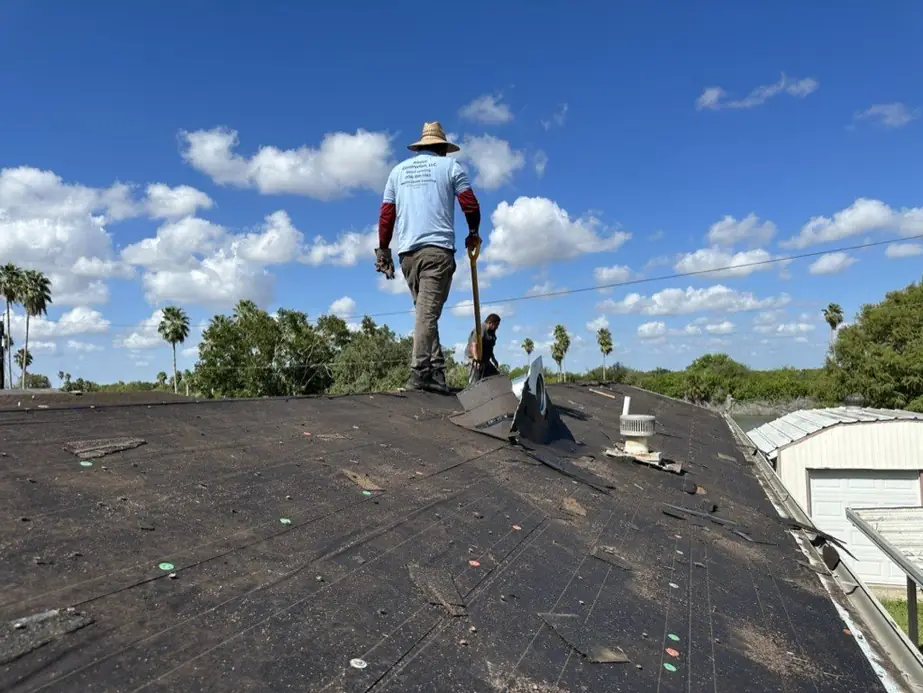
Roofer on a stripped roof deck with palm trees on the horizon
Inspection, photo report and a line-item estimate
The crew inspects slope by slope: shingle or panel condition, metal components, penetrations like pipe boots and chimneys, then the attic for staining, daylight through the deck and wet insulation. Measurements are taken as well, covering pitch, total squares and layer count. Every finding is tied to a location and photographed with a date.
The estimate is written in Xactimate, a line-item platform widely used across the property repair industry. Each component is its own line, so the scope can be reviewed piece by piece instead of as one lump figure. If water is coming in while all of this is underway, the crew can tarp and dry in the roof first. Repairs follow to manufacturer specs, with Owens Corning roofing products.
Ariston is a roofing contractor, not an adjuster. It does not decide what a policy covers and cannot promise what an insurer will pay. One customer, Brenna P., wrote that “Oscar worked with the insurance agent to get more for the work needed.” What your claim pays is settled between you and your insurance company.
What to do after the storm, and when to call again
Stay off the roof, since walking on hail-bruised shingles does more damage. Deal with active water first, photograph interior damage before cleaning up, and keep every inspection report, estimate and receipt. Call your insurer about your coverage, your deductible and what the policy asks of you.
Then call Ariston at (956) 345-7700 for a free inspection. Crews work out of La Feria and cover Harlingen, McAllen, Brownsville, Edinburg, Weslaco and Mission, and the company is bonded, general-liability insured and licensed by the Texas Department of Housing & Community Affairs as a manufactured housing installer, MHDINS00004804.
If the inspection shows hail took the whole roof, the estimate lays replacement beside the repair. After a later storm, a new inspection is quick, and the earlier photos give you something to compare against.
Bonded and insured · Texas TDHCA installer license MHDINS00004804 · Owens Corning roofing products · free inspection
Ridge
What the photo report holds
Storm damage is time-sensitive and the roof eventually gets repaired. What survives is the record. Questions about it go to (956) 345-7700.
- Overviews
- One wide photo of each slope, so damage can be placed on the roof.
- Close-ups
- Bruised or creased shingles, lifted seals and missing tabs, with a date on each.
- Metal and penetrations
- Vents, flashing, drip edge, ridge caps, gutters, pipe boots, chimney and skylight curbs.
- Measurements
- Pitch, total squares, slope dimensions and the number of shingle layers.
- Interior
- Ceiling staining, attic decking, daylight through the boards and wet insulation.