What Hail Does to a Shingle Roof in the Valley, and Why a Dated Photo Report Helps
Hail can damage a roof without leaving a hole, and the record you keep afterward matters as much as the repair.
October 17, 2026 · 4 min read
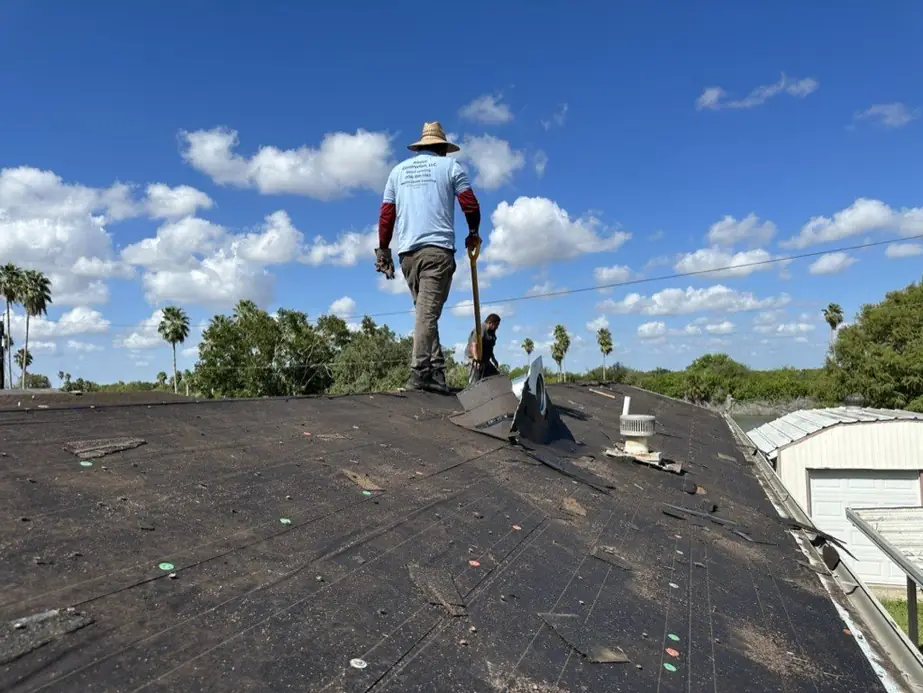
A roof can look fine from the driveway and still be carrying storm damage. Hail doesn't have to punch a hole to hurt a shingle, and most of what it does happens in places a homeowner can't see from the ground. Knowing how the damage works makes it easier to decide when to call someone and what to keep on file.
How hail damages a shingle
An asphalt shingle is a fiberglass mat coated in asphalt and covered in mineral granules. The granules protect the asphalt from the sun, which in the Rio Grande Valley is a daily job. A hailstone that lands hard enough can knock granules loose, bruise the mat underneath, or fracture it outright. Because a bruise often doesn't break the surface, the top of the shingle can look intact while the mat below has cracked. That spot then ages faster than the shingle next to it, and the first sign may be a leak months later rather than anything you noticed on the day of the storm.
Hail also dents soft metal: roof vents, flashing, drip edge, gutters and metal panels. Dents in those parts are useful evidence, because they show which way the storm came from and how hard it hit, even when the shingles themselves look quiet.
Hail and wind leave different marks
Storms here damage roofs in two different ways, and the repair isn't the same for both. Hail strikes the roof surface directly, and the damage tends to spread across the slopes that faced the direction the stones fell. Wind works at the edges. It lifts and creases shingles, breaks the adhesive seal that holds each course down, and pulls at ridge caps, drip edge and flashing, so wind damage concentrates along edges, ridges and corners rather than across a whole slope.
One storm often does both. A roof can lose a few shingles to wind while the shingles that stayed put are bruised by hail. That's why a proper inspection looks at the whole roof as a system instead of only counting the obvious missing pieces.
What you can check safely from the ground
Stay off the roof. A storm-damaged roof is unstable, and walking on bruised shingles can crack more of them. From the yard and from inside the house you can still gather useful information.
- Granules collecting in gutters, downspouts or at the splash blocks under them
- Dents in vents, flashing, gutters or metal roof panels
- Shingles that are missing, lifted, curled or creased
- Bent or displaced ridge caps
- Flashing pulled away from walls, chimneys or pipes
- Water stains on a ceiling, or daylight visible through the roof deck from the attic
- Limbs or debris resting on the roof
Photograph whatever you find, with the date on the file. Move belongings out from under any active drip first, and photograph interior damage before you clean it up.
Why a dated photo report helps with your adjuster
Insurance claims run on records. The roof will be repaired eventually, and once it is, the damage is gone. What survives is the documentation. A good roof report ties dated photographs to locations on the roof: an overview of each slope, close-ups of the specific damage, the metal parts and penetrations, measurements, and interior photos where water has come in. Ariston Construction builds that report during its free inspection, and it's written so an adjuster can read it without having been on the roof.
The report is a record of what the damage was, where it was and when it was observed. It is not a coverage decision. Ariston is a roofing contractor, not an insurance adjuster, so what your policy pays, what your deductible is and what your carrier needs from you are questions for your insurance company. Call them early, ask what they require, and keep every inspection finding, photograph, estimate and receipt in one folder.
Repair or replace
Not every storm-damaged roof needs replacing. Repair generally suits damage that's localized, such as a handful of missing shingles, a damaged flashing detail or a failed pipe boot, on a roof whose remaining surface and decking are sound. Replacement becomes the realistic answer when damage spreads across several slopes, when hail bruising has compromised the shingle mat broadly, when the roof was already near the end of its life, when decking has deteriorated over a wide area, or when the existing shingle can no longer be matched.
Measurements and photos are what turn that into a judgment about your actual roof instead of a guess. If replacement is the answer, Ariston installs Owens Corning roofing products and offers impact-rated Class 4 shingles (tested under UL 2218) as an option. Every roof system is registered in the homeowner's name, with a certificate and a photo record of the underlayment, flashing and ridge.
Getting a roof looked at
Ariston Construction has worked in roofing, remodeling and home leveling around the Valley for over 35 years, from its base in La Feria. The inspection is free, and the estimate comes in writing, itemized, before any work starts. Senior and military discounts are available, and financing is offered through Acorn Finance. The company is fully bonded and general-liability insured.
If a storm has come through your neighborhood, the Storm & Hail Damage Repair page lays out the whole inspection process, or call (956) 345-7700 and ask for a roof inspection.
Ariston Construction LLC, (956) 345-7700
Call (956) 345-7700More articles
Re-Leveling a Manufactured or Park Model Home: Signs, Piers, Tie-Downs and Storm Checks
A home on piers relies on the pier and anchor system staying where the installer left it, and in Valley clay it rarely does.
Underbelly Insulation: What Animals, Water and Ductwork Do Under a Mobile Home
The belly wrap, the insulation and the ducts under your floor work as one system, and when one fails the others follow.