Re-Leveling a Manufactured or Park Model Home: Signs, Piers, Tie-Downs and Storm Checks
A home on piers relies on the pier and anchor system staying where the installer left it, and in Valley clay it rarely does.
October 17, 2026 · 4 min read
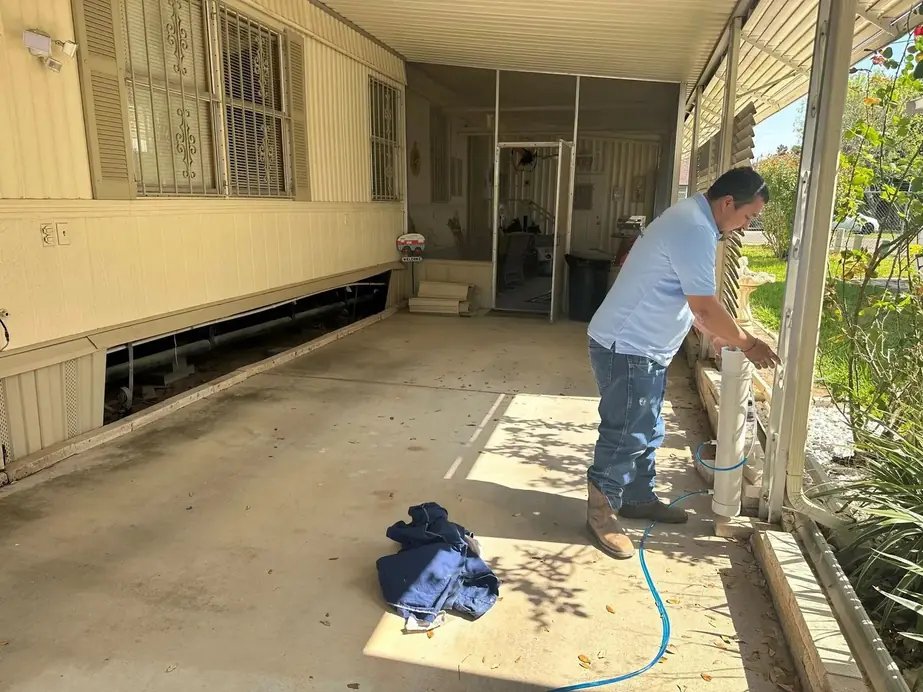
A manufactured home sits on piers and anchors, not on a poured foundation. That makes it easy to set up and easy to shift. In the Rio Grande Valley the shift is usually slow, which is why so many owners notice it only when a door starts to stick. This guide covers what moves, what to look for, and when to have the whole system checked.
Why a home on piers drifts out of level
The clay under the Valley swells in wet weather and shrinks in dry spells, and the pads under each pier don't all move at the same rate. Some settle, some stay put, and over a few seasons the frame picks up a twist. Dry-stacked block piers can lean, pads can crumble, and a pier set on a footing too small for the soil will sink into wet ground. The home above has no say in the matter. It simply follows whichever corner drops.
Homes that have been moved or sited in a hurry are especially prone to this, since the piers are sometimes whatever was on hand that day. Older homes, whose pads have had decades to bed in unevenly, are prone to it too.
Signs your home has moved
- A door that has to be lifted to latch, or one that swings open on its own
- Windows that bind in one season and free up in another
- A ripple or slope in the floor, or a marble that always rolls the same direction
- Cracks in the ceiling or drywall that reopen in the same place
- On a double-wide, a gap opening along the marriage line where the two halves meet
- Skirting pulling away from the floor line
Any one of these can have another cause. Two or three on the same side of the home point to a floor that has moved, and a set of elevation readings will settle the question.
What re-leveling involves
The work starts with readings the full length and width of the home, so the low point is found by measurement rather than by eye. Piers that have dropped are reset, and crumbled pads or undersized footings are replaced with footings sized to the soil. Ariston Construction is licensed as a manufactured housing installer by the Texas Department of Housing & Community Affairs, license MHDINS00004804, and manufactured and park model homes are the work Ariston does.
Double-wides get extra attention at the marriage line, because a small height difference between the two halves shows up there first, as a gap you can see light through. Leveling also tends to disturb skirting, so it should be refit afterward with the vents kept clear and the space under the home still able to breathe.
Tie-downs and anchors
Piers carry the weight. Anchors and straps hold the home down in wind. Anchor spacing and strap counts depend on the home's wind zone and its length, and nobody looks at them until something goes wrong or a lender or insurer asks. In this humidity, galvanized strapping can corrode years before anyone expects it to.
A proper check counts the anchors, looks for corrosion and pull-out, confirms the angle, and replaces what has failed instead of re-tensioning a strap that's already weakened. A home installed decades ago may be under-anchored by what's expected today, so count what's actually there before assuming. If a lender or insurer wants evidence, photographs of the finished work and a record of what was installed make that conversation short.
Re-check every two to three years, and after named storms
Plan on a check every two to three years, and after any named storm or an unusually wet or dry season. A new site can need its first correction inside the first couple of years, because pads bed in as the ground settles around them. Catching a low corner early is a small job. Waiting turns it into stuck doors, cracked ceilings and a floor with a permanent memory of the slope.
After a named storm, check even if nothing looks different. Wind loads the anchors, and saturated ground softens the pads. Walk the perimeter, look at the skirting, look for any pier that has started to lean, and notice whether the doors still close the way they did the week before. If you're a winter resident who is away for the summer, ask a neighbor or the park manager to look in after a storm, and schedule a visit for the week you return.
What to expect from a visit
Ariston's pier and anchor inspections are free and carry no obligation, and the written estimate is itemized before any work begins. Senior and military discounts apply, and financing is available through Acorn Finance. The company is fully bonded and general-liability insured, and has been working in roofing, remodeling and leveling around the Valley for over 35 years.
The Mobile Home Leveling & Tie-Downs page has the full list of what Ariston does under a manufactured or park model home. To book a free pier and anchor check, call (956) 345-7700.
Ariston Construction LLC, (956) 345-7700
Call (956) 345-7700More articles
What Hail Does to a Shingle Roof in the Valley, and Why a Dated Photo Report Helps
Hail can damage a roof without leaving a hole, and the record you keep afterward matters as much as the repair.
Underbelly Insulation: What Animals, Water and Ductwork Do Under a Mobile Home
The belly wrap, the insulation and the ducts under your floor work as one system, and when one fails the others follow.